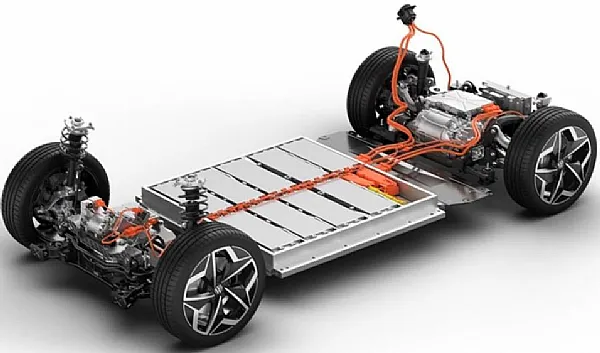
Beijing Benz's new EQE pure electric medium-sized SUV was launched recently. The car is built on the Mercedes-Benz EVA pure electric platform and provides two driving forms: single-motor rear drive and dual-motor four-wheel drive; SAIC-GM-Wuling recently announced its new small electric vehicle. The guide price of the SUV Baojun Yueye uses a rear-mounted rear-drive drive; simultaneously, the Tesla Model Y rear-drive version equipped with BYD's blade battery rolled off the assembly line in Berlin, Germany. Electric models such as Feifan F7, Haobo GT, and Nezha S that have been unveiled or launched recently also provide rear-drive versions. In addition, including Tesla, Volkswagen, Volvo, Polestar, Hyundai, Kia, Nezha, Changan, etc., more brands have begun to join the rear-wheel drive camp.
Electrification promotes the popularity of rear-wheel drive vehicles.
Among the brands that have switched from front-wheel drive to rear-wheel drive, Volvo is quite representative. Volvo is expanding and improving its 2024 electric vehicle product line, of which the pure electric versions of the XC40 and C40 are expected to be on the market as soon as the fourth quarter of this year. The new car continues the current model's design in terms of appearance and interior. The biggest change is the introduction of a rear-drive single motor as a standard version for the first time, replacing the current front-drive single motor. Adjusting the motor's position also means that Volvo's rear-wheel drive has finally returned to the era of electrification after 25 years of absence.
According to official information, the two new cars use a 175kW rear motor, replacing the current model's 170kW front motor. Thanks to the improved cooling efficiency and the same 69kWh battery pack, the driving range of the new XC40 pure electric version under WLTP conditions has increased from 425 kilometers to 460 kilometers, and that of the C40 pure electric version has increased to 476 kilometers. Both increased by nearly 10%. In addition to the basic version, these two new cars provide a high-power rear-drive version, using a 185kW rear motor and an 82kWh battery pack. In addition, the new car also provides a four-wheel drive version, which uses a dual-motor combination and is equipped with an 82kWh battery pack.
Not surprisingly, Volvo's high-performance electric car brand Polestar has also made the same choice. In April, Polestar announced a major upgrade and remodel of its pure electric coupe Polestar 2, launching the 2024 Polestar 2. The new car is equipped with a newly developed drive motor by Polestar. More importantly, Polestar 2 has changed its drive form. The motor of the single-motor version is moved from the front axle to the rear axle, making this car the first rear-drive model under Polestar.
That said, Volvo and Polestar join the likes of Tesla, Volkswagen, Hyundai, and Kia in making rear-drive versions the base version of their EVs. Especially, Tesla, the brand, is a loyal supporter of rear-wheel drive. The hot-selling Model 3 and Model Y both adopt the rear-drive layout, and the high-performance version uses an additional set of motors on the front axle to form a four-wheel drive.
Looking at China, Nezha S, Nezha GT, Xiaopeng P7, Zhiji L7, Jikrypton 001, Wenjie M5, etc., all provide two versions of single-motor rear drive and dual-motor four-wheel drive. The rear-drive layout is one of the selling points of the Deep Blue S7, which was pre-ordered on May 20 this year. Leaving aside these electric models worth more than 150,000 yuan, even the Bao Junyue, with a starting price of 79,800 yuan, and the Wuling Hongguang MINI EV, with a starting price of 32,800 yuan also adopts a rear-mounted rear-drive layout.
The pure electric platform prefers the rear-drive layout.
Why are more and more EVs moving to rear-wheel drive? This may start with the different characteristics of the front drive and the rear drive. Rear drive, as the name suggests, is driven by the rear wheels, and the front wheels can focus on steering, making the vehicle more agile when turning and bringing stronger handling. When the vehicle accelerates or climbs a slope, because the center of gravity shifts backward, the rear wheel acts as the driving wheel to enhance the grip, which is conducive to the vehicle showing stronger power and speed performance during driving. However, in fuel vehicles, the engine and transmission are distributed at the front of the vehicle, and power transmission to the rear wheels through the transmission shaft will inevitably result in higher losses than in front-wheel drive vehicles.
As we all know, most products are built in the front-wheel drive mode in the traditional fuel vehicle market. On the one hand, the cost of using the front-wheel drive layout is lower; on the other, it is from the perspective of space utilization and transmission efficiency. In contrast, the rear drive is stronger in handling, but the cost is higher, the car's interior space is relatively small, and the fuel consumption is higher. Therefore, family car brands that pursue comfort and cost-effectiveness in the era of fuel vehicles adopt the front-drive model. In contrast, sports or luxury models that pursue maneuverability prefer the rear-drive model.
In the era of electric vehicles, many in the early stage were "oil-to-electricity." To minimize the changes in the layout of the vehicle structure, these electric vehicles often retain the original power system layout. For example, the BAIC New Energy EV series, GAC Toyota C-HR EV, FAW Toyota Yize E Jinqing, Nissan Leaf, and Volkswagen e-Golf still use the front-drive mode.
However, with the accelerated electrification transformation, car companies are no longer satisfied with"oil-to-electricity." Building pure electric vehicle platforms has become the common choice of mainstream car companies, such as Volkswagen's MEB platform, GM'ss auto platform, Toyota's e-TNGA platform, Hyundai and Kia E-GMP platforms, etc. Since the motors of electric vehicles are small in size, they are relatively flexible in arranging. There is no engine, transmission, or transmission shaft, so there is no need to be"so "car" full" in space layout, and the motors placed on the front and rear axles will not produce too much cost difference. Therefore, when many car companies develop a new pure electric platform, they tend to choose a rear-drive layout with more advantages in terms of power.
Take Changan Deep Blue SL03 as an example. The car is basedChangan'san's new EPA1 pure electric platform. It is also the first model of this platform and adopts a rear-mounted rear-drive layout. Models such as Hyundai IONIQ 5, Hyundai IONIQ 6, and Kia EV6 based on the E-GMP platform, as well as models such as ID.4, ID.6, and ID.7 based on the Volkswagen MEB platform, all use the rear-drive version the basic version and provide High-performance four-wheel drive version.
Improve driving pleasure and optimize space.
Based on the single-motor rear-drive version, it also provides a high-performance dual-motor four-wheel drive version. This optional configuration has been adopted by more and more electric vehicles. Carsten Bennewitz, director of Volkswagen brand engine research and development, said that the current ID. The electric vehicle series is mainly rear-wheel drive. He also said that in the future, electric cars from the VW brand will either have rear or all-wheel drive."
"We believe electric vehicles are the only way to solve the emissions problem in Europe and globally. But driving pleasure is key to convincing consumers to switch to electric vehicles. By installing rear-wheel drive as the main propulsion system, we can improve the car's driving dynamics. If you create some advantages in terms of learning, the traction and acceleration of the car will also be improved."
David Labros, head of product planning at the Hyundai European Technology Center, also sa"d: "The electric motor can provide near-instant torque, which allows us to achieve amazing acceleration" on." It is easy to accidentally make the tires slip due to a too-fast start, especially when accelerating in turn. The use of a rear motor can alleviate this problem.
Polestar product development director Christian Samson pointed out that rear-wheel-drive models have generally had a drawback in the past. Due to insufficient traction, rear-wheel-drive models can be unstable at certain times. One reason Volvo stopped producing rear-wheel-drive models in 1998 was that it believed front-wheel-drive models were safer. But traction control systems for rear-wheel-drive vehicles have improved in recent years, and electric vehicles can distribute their weight more evenly across the front and rear wheels, giving them a better grip on roads, especially when the ground is slippery. Down.
Volvo and Polestar also point out that rear-wheel-drive vehicles perform better and are more efficient. For example, compared with the front-drive model, the maximum output power of the Polestar 2 rear-drive model equipped with a single motor has been increased from 170kW to 220kW, and the torque has been increased from 330N·m to 490N·m. According to Polestar, these changes have shortened the acceleration time of the new car from 100 kilometers to 1.2 seconds. Joachim Lüdholm, Chief Chassis Engineer of the Polestar brand, said" "The improved traction and response speed of the new car will bring more driving pleasure to car owners. Increased comfort in difficult situations"."
In addition, the rear motor takes up less space, and interior designers can move the cab forward to create more space for the cockpit and luggage compartment without a traditional engine, drive shaft, etc.
Many of the hot-selling electric models on the market are front-drive models. Still, the growth trend of rear-drive models is very obvious, especially the new electric models based on pure electric platforms are more inclined to choose the rear-drive layout while providing a High-performance four-wheel drive version to bring consumers a better driving experience, to stand out from the competition.