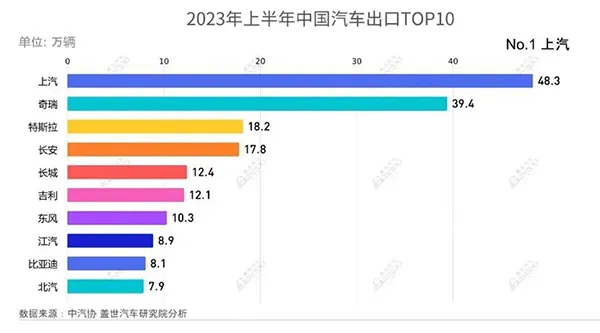
In the first half of 2023, Chinese auto companies exported 2.14 million vehicles, a year-on-year increase of 75.7%. In terms of vehicle types, 1.78 million passenger vehicles were exported, a year-on-year increase of 88.4%; commercial vehicle exports were 361,000 units, a year-on-year increase of 31.9%. The export of new energy vehicles reached 534,000 units, a year-on-year increase of 1.6 times. Among the top ten enterprises exporting complete vehicles, SAIC holds the top spot with a sales volume of 483,000 vehicles. Chery exported 394,000 vehicles, a year-on-year increase of 1.7 times.
All kinds of information indicate that China has "quietly risen" to become a world auto power
2009: Car sales rank first in the world for the first time
2009 is a representative year. China produced a total of 13.791 million vehicles and sold 13.6448 million vehicles, surpassing the United States for the first time to rank first in global sales. Since then, China has become the world's largest automobile producer and seller for 14 consecutive years.
On December 23, 2009, Ford Motor of the United States and China's Zhejiang Geely Holding Group announced that the two parties had reached a preliminary agreement on Ford's sale of its Volvo Car to Geely. On March 28, 2010, Geely Holdings and Ford Motor formally signed an agreement in Gothenburg, Sweden. Geely acquired 100% of Volvo Cars for US$1.8 billion. In August 2010, Geely officially completed the acquisition of Volvo, a luxury car brand. This acquisition is not only the first acquisition of a well-known international luxury car brand by a Chinese auto brand but also the first time that a Chinese private auto company has attracted the attention of the global auto industry.
However, foreign brands still dominated the Chinese auto market at that time, especially Volkswagen, which has been the most-sold brand in the Chinese market for many years. In 2009, Volkswagen Group sold 6.29 million vehicles worldwide, and the Chinese market sold 1.4 million, accounting for 22%. It has become the largest single market for Volkswagen in the world, surpassing Germany (1.24 million). Ten years later, in 2019, the global sales volume of the Volkswagen Group reached a record 10.9746 million vehicles, and the overall sales volume in the Chinese market was 4.2336 million vehicles, accounting for 38.6% of the group's global sales volume, close to 40%.
According to statistics, in the nine years from 2013 to 2021, the sales volume of the Volkswagen brand in China was 25.14 million vehicles, the sales volume of the Toyota brand in China was 11.46 million vehicles, the sales volume of the Honda brand in China was 11.15 million vehicles, the sales volume of the Nissan brand in China was 9.24 million vehicles, and the sales volume of the Buick brand in China 8.53 million vehicles, Geely brand China sales of 7.7 million vehicles, Hyundai brand China sales of 7.43 million vehicles, Haval brand China sales of 5.78 million vehicles, Wuling brand China sales of 5.76 million vehicles, and Audi brand China sales of 5.54 million vehicles.
In 2009, the sales volume of self-owned brand passenger vehicles in China was 4.577 million, accounting for 44.3% of the total sales volume of passenger vehicles. However, the proportion has fluctuated since then. With the steady improvement of residents' living standards, the proportion of luxury car sales in the Chinese market has gradually increased. For many years since then, the three major German brands represented by BBA (Mercedes-Benz, BMW, and Audi) have dominated the Chinese luxury brand market.
2022: The sudden emergence of BYD
BYD was once synonymous with low-end car brands. However, it was favored by the "stock god" Buffett. In September 2008, Buffett's Berkshire Hathaway bought 225 million BYD H shares atforK$8 per share for HK$1.8 billion and has held shares for nearly 14 years until June 30, 2022. No change. the
Over the next ten years, BYD took the lead in entering the field of new energy vehicles by its advantages in battery technology. The stock price is also fluctuating, but the sales volume of automobiles is still not as good as that of private brands such as Geely and Great Wall. In 2016, the annual sales volume of Great Wall Motor exceeded 1 million vehicles for the first time, and in 2017, the annual sales volume of Geely Automobile exceeded 1 million vehicles for the first time.
On the other hand, BYD Auto’s sales volume in 2016 was 489,000 units. In 2017, sales volume dropped to 409,000 units. In 2018, it increased to 520,700 units. In 2019, it fell to 451,000 units. Annual sales have been hovering at 400,000 to 500,000.
During this period, in July 2018, the American electric vehicle brand Tesla announced its establishment in Shanghai. In January 2019, Tesla's Shanghai Gigafactory broke ground. On December 30, 2019, the domestic Model 3 was officially delivered to employee car owners at the Shanghai factory. Tesla's Shanghai factory started construction that year and put into production new cars that year.
Tesla is like a catfish, making waves in China's new energy vehicle market.
The turning point comes in 2021. The accumulative sales volume of BYD's passenger vehicles in the whole year was 740,000 units, a significant increase of 75.4% over the previous year. Among them, the sales volume of new energy passenger vehicles was 593,700, a sharp increase of 231.6% year-on-year. BYD's new energy vehicles experienced a blowout growth this year. The sales of Qin, Han, Tang, Song, and Yuan brands, which were newly replaced by the BYD Dynasty family, have all achieved substantial growth. Compared with the previous generation, these models have made great progress in terms of internal technology and appearance. Even German and Japanese auto companies will buy back these models for special research.

Entering 2022, BYD has continued to set new sales records, and broke through the monthly sales of 100,000 vehicles for the first time in March, reaching 104,338 vehicles. On April 3, 2022, BYD Auto officially announced that it will stop the production of fuel vehicles from March 2022. This unexpected move also made BYD the first large car company in the world to officially announce and stop the production of fuel vehicles. One stone caused a thousand waves, and since then BYD's sales have been on a rocket, creating new heights every month. By September, BYD's monthly sales exceeded 200,000 vehicles for the first time, reaching 201,300 vehicles. The cumulative output in the first nine months reached 1,185,100 vehicles, and the annual sales volume exceeded 1 million vehicles for the first time. By the end of 2022, BYD Auto's annual cumulative sales will reach 1,868,500 vehicles, an increase of 153% over 2021, creating a miracle for global auto companies.
In 2023, BYD's sales will continue to maintain strong momentum. In the first five months, car sales exceeded 1 million, and the cumulative sales in the first half of the year reached 1,255,600. BYD plans to sell more than 3 million vehicles for the whole year. If this result can be achieved, BYD will become the first Chinese auto group to break into the top ten in global sales.
2023: Export volume ranks first in the world
The development of China's auto industry has also imperceptibly promoted the export of Chinese-made cars.
In 2012, China's automobile export volume exceeded one million for the first time, reaching 1.015 million. But in the next few years, it has been slowly declining, and by 2016, the export of complete vehicles even dropped to 708,000. However, there was a rapid increase in export volume subsequently. In 2018, the number exceeded 1 million again, reaching 1.15 million.
Despite the impact of the epidemic in 2020, China's auto exports fell slightly to 995,000 units, a year-on-year decrease of 2.9%. However, passenger car exports reached 760,000 units, a year-on-year increase of 4.8%. In 2021, China's auto exports will exceed 2 million, reaching 2.015 million. In 2022, China's auto export volume will exceed 3 million units, reaching 3.11 million units, surpassing Germany for the first time, and becoming the world's second-largest auto exporter after Japan. Among them, 2.529 million passenger vehicles were exported, a year-on-year increase of 56.7%.
In the first quarter of 2023, China surpassed Japan and Germany to become the world's largest car exporter for the first time, with exports exceeding the 1 million mark. In the first three months of this year, a total of 1.069 million new cars were exported domestically, and Japan's car exports in the first quarter were 1.047 million. In the first half of the year, auto companies exported 2.14 million vehicles, a year-on-year increase of 75.7%.
Statistics from the General Administration of Customs show that in 2021, the top ten countries in China's vehicle export volume will be Chile, Saudi Arabia, the Russian Federation, Belgium, Australia, Mexico, Egypt, Bangladesh, the United Kingdom, and the Philippines. In the first quarter of 2023, the top ten countries in China's auto product export value are Russia, the United States, Mexico, the United Kingdom, Belgium, Japan, Australia, Germany, the United Arab Emirates, and South Korea.

Although China's auto exports were once driven by foreign automakers such as Tesla, according to statistics from Gasgoo, the top ten automakers in China's auto exports in the first half of 2023 are SAIC with 483,000 vehicles, Chery with 394,000 vehicles, Tesla with 394,000 vehicles. Pull 182,000 vehicles, Changan 178,000 vehicles, Great Wall 124,000 vehicles, Geely 121,000 vehicles, Dongfeng 103,000 vehicles, Jiangqi 89,000 vehicles, BYD 81,000 vehicles, and BAIC 79,000 vehicles. It can be seen that the export of local Chinese car companies is still the main one. And this huge change happened in just a few years.
SAIC Motor stated that in the first half of 2023, the MG brand sold 115,000 vehicles in Europe, an annual increase of 143%, of which new energy vehicles accounted for more than 50%. At present, MG brand products and services have covered 28 countries in Europe, and the monthly delivery volume in Europe has exceeded 20,000 vehicles for four consecutive months. SAIC expects its overseas sales to exceed 1.2 million vehicles in 2023.
Chinese auto brands have taken center stage
Not long ago, some foreign media commented that China has shocked the global auto industry twice this year.
The first time a Chinese-produced electric car stunned Western rivals with quality, features, and price at the Shanghai Auto Show. Subsequently released data showed that in the first quarter of 2023, China replaced Japan as the world's largest car exporter. China's lead in the electric vehicle industry is also a blow to the West. Competitive pressure and creativity make electric vehicles designed and built in China formidable competitors. Gasoline car makers are product-oriented, while electric car makers, like technology companies, are user-oriented. At the same time, Chinese suppliers such as Ningde Times have also changed from laggards to leaders.
On the 2023 Top 100 Global Auto Parts Suppliers (2023 Top Suppliers) list released by Automotive News based on the 2022 auto supporting revenue of each manufacturer, China (including Hong Kong) has a total of 13 companies on the list, Ningde Times jumped to the fifth place.
According to data released by South Korean market research organization SNE Research, the total number of newly registered global battery installations in the first five months of 2023 increased by 52.3% year-on-year to 23237.6 gigawatt hours (GWh). The installed volume of the Nthe single era increased by 59.6% year-on-year, ranking first in the world with a market share of 36.3%; BYD's installed volume increased by 107.8% year-on-year, with a market share of 16.1%, ranking second.
According to the data from Counterpoint, a Hong Kong research company, judging from the global sales of pure electric vehicles (EV) and plug-in hybrid vehicles (PHV) from January to March 2023, the share (share) of BYD in China is higher than that of the previous quarter. Increased by 1.3 percentage points to 21%, ranking first. Topped the list for 4 consecutive quarters. The second place is Tesla of the United States, with a year-on-year increase of 3.9 percentage points to 16%. Others in the top ten share: Volkswagen (6.9%), Geely (5.9%), General Motors (4.7%), Mercedes-Benz (4.4%), BMW (4.2%), Stellantis (4%) %), Hyundai (4%) and Renault (3.9%).
According to the retail sales ranking of Chinese passenger car manufacturers in June 2023 released by the Passenger Federation, the top ten are BYD (231,230 units), FAW-Volkswagen (178,642 units), Changan Automobile (118,057 units), Geely Automobile (115,270), SAIC Volkswagen (98,833), GAC Toyota (86,354), SAIC-GM (79,521), Tesla China (74,212), FAW Toyota (70,795) and Great Wall Motor (68,388).
China's self-owned brand car companies are finally on par with foreign brands.