10/19/2022
Here is a guideline for importing used cars from China, with Import Policy and Regulation Guide by Country. Hope it helps you. If you want to know more about importing new and used cars from China and related issues, please contact us.
Kazakhstan is a country with left-hand drive, and the number of cars per thousand people is about 250. According to Marklines data, new vehicles in Kazakhstan in 2020 will increase by 23.8% year-on-year. At the same time, according to data from the Kazakhstan Automobile Industry Association, the number of newly registered motor vehicles13 in Kazakhstan in 2020 will decrease by 8.2%. Among them, 1.224 million motor vehicles were transferred and registered, a year-on-year decrease of 11.7%; 14.6 were registered for the first time, a year-on-year increase of 30.8%. In terms of used cars, the age of used cars in Kazakhstan is relatively high. According to the Kazakhstan Automobile Industry Association data, motor vehicles aged more than 20 years have accounted for 26% of 11-20 years old, 10% of 8-10 years old, and 17% of 4-7 years old. The 1-3 years proportion is 5%, lower than 1% for one year. The best-selling second-hand models in the region include Toyota Harrier, Toyota Camry, Toyota Land Cruiser, Toyota Prado, Toyota Corolla/Corolla Aqua, Toyota Rav4, Toyota Prius, Honda Fit, etc.
#2. Used car import policies and regulationsKyrgyzstan is a left-hand drive country with about 220 cars per thousand people. There is almost no local automobile industry in Kyrgyzstan, and the automobiles are mainly second-hand cars. According to the World Automobile Organization (OICA) data, Kyrgyzstan's average annual car sales in the past ten years has been around 3,800, but in 2011 it was only 1,505. Kyrgyzstan imported used cars from Japan, Germany, Russia, the United States, and South Korea. Japanese brands have a relatively high market share in the local market, and Toyota occupies a dominant position in the country's used car market. The best-selling second-hand models in the region are Honda Fit, Mazda Bongo and Vanette, Toyota TownAce, Toyota Land Cruiser, Toyota Wish, Toyota ISIS, Toyota FJ Cruiser, etc.
#2. Used car import policies and regulationsRussia is a left-hand drive country, but it also allows the import of right-hand drive vehicles. The number of cars per thousand people is about 373. According to the data released by Marklines, the sales volume of Sri Lankan automobiles (including light commercial vehicles) was 1.599 million, a year-on-year decrease of 9.1%, falling for two consecutive years; imported passenger cars were 243,000, a year-on-year decrease of 1. The best-selling brands were Kia, Lada, Hyundai, and Renault; these four brands account for about half of the market share in Russia. The trading volume of second-hand cars in Russia is about 5.5 million, and the annual import volume of second-hand cars is about 700,000. Among them, 33% of the vehicles are more than 15 years old and 11 to 15 years old, and the vehicle age is relatively high. According to the news released by Avtostat-Info, the demand for used cars of Chinese brands in Russia will increase by 28% in 2020. The best-selling models include Chery Tiggo, Great Wall Haval, Lifan X60, Lifan Solano, and Geely Emgrand. Chinese used cars are most popular in Snodar Krai, Bashkortostan, and Sverdlovsk Oblast. Russian used cars are mainly imported through ports such as Vladivostokoff, Magadan, St. Petersburg, and Novorossiysk. The best-selling second-hand models in the area include Toyota Land Cruiser, Toyota Pura, Toyota Corolla, Toyota Hiace, Toyota Passo, Suzuki Swift, Nissan Note, Mitsubishi pickup, etc.
#2. Used car import policies and regulations1. Import policy
Used cars imported from Russia must meet the Euro V emission standard, be within five years, and install the ERA-GLONASS emergency call system (in US dollars). At the same time, for used cars over three years old, obtaining a vehicle structure safety certificate (SBKTS certification 1), Relevant requirements of Vehicle Safety Technical Regulations (TR—CU018/2011) is necessary.
2. Tax policy
Used cars imported into Russia need to pay a 15% tariff, 20% value-added tax, a consumption tax of 1000-5000 US dollars, 1000-5000 purchase tax, etc. At the same time, from May 4, 2020, to December 31, 2021, the import tariff of electric vehicles (excluding hybrid vehicles) imported into Russia will be 0, in addition:
(1) Individuals who permanently emigrate to Russia from other countries can import a car (including new cars) with a displacement not exceeding 1.8L tax-free.(2) Russian permanent residents who stay abroad for more than six months can import a second-hand car with a displacement of no more than 1.8L tax-free.
(3) Vehicles imported into Russia as legal capital of foreign-invested enterprises are exempt from VAT within one year from the date of enterprise registration. Vehicles imported temporarily for the personal use of foreign residents or members of the importer's family and which have not been used for more than one year are exempt from customs duties. If the vehicle has been used for more than one year, 3% of the total price of the vehicle will be charged as a tariff every month. After the vehicle is re-exported, the relevant fees will not be refunded. If the vehicle is sold in Russia, the monthly fees paid are included in the customs duties to be paid.
3. Documents required for import:
Belarus is a country with left-hand drive, and the number of cars per thousand people is about 360. Sales of automobiles (including light commercial vehicles) in 2020 will be 54,000 units, almost falling to the level of 2018 year-on-year. The most popular car brand in 2020 is Lada, Geely, Renault, and others are also highly accepted. According to Belarus Automobile Data, the number of Chinese brand cars sold in Belarus in 2020 will be 9,648, a year-on-year increase of 31.5%, and the market share will reach 18.3%, a year-on-year increase. From the perspective of car companies, Geely Automobile sold 9,200 vehicles, ranking first among Chinese car companies; Haval, Chery, Zotye, and Changan ranked 2-5, respectively. In response to the call of the Belarusian government to realize the localization of electric vehicles as soon as possible, Geely Auto Belarus Branch plans to import 500-1 vehicles in 2021 to investigate market demand and make necessary preparations for production. Electric vehicles produced in Belarus are expected to be launched in the second half of the year. In January 2021, the Belarusian government's "2021-2025 National Electric Vehicle Development Plan" included state procurement, tax incentives for the purchase of electric vehicles, and policies and measures for the recycling and development of electric vehicles. About 1,600 electric vehicles in Belarus are expected to grow to tens of thousands in the next few years. In terms of used cars, Belarus mainly imports used cars from countries such as Germany, Japan, and Russia. The local best-selling second-hand models include Toyota Hiace, Toyota Cruiser, Toyota Prado, Honda Fit, Toyota Corolla, Toyota Aqua, Toyota RAV4, and Toyota Prius.
#2. Policies and regulations on the import of used carsFrom July 1, 2016, Belarus requires that all used cars imported into Belarus have at least one front airbag and be equipped with a fixed point. Currently, there is no age requirement. From May 4, 2020, Belarus began to tax imported electric vehicles (excluding hybrid vehicles, valid until December 31, 2021. For temporarily imported vehicles, according to Article 264 of the "Eurasian Economic Union Customs Law," Temporary imports by natural persons from non-Eurasian Union member four countries are valid for no more than one year and must be declared in writing using the Passenger Customs Declaration, before the expiry of the one year, the territory of the car must be taken out of the territory. Unless the vehicle Confiscation by court decision or acquisition of goods status in the Eurasian Union under Article 16, paragraph 2, or Article 382, paragraph 6, of the Eurasian Economic Union Customs Code, or under Article 14 of the Eurasian Economic Union Customs Code Otherwise, the vehicle shall be deemed to be a vehicle for own use paying all prescribed duties, etc.
Ethiopia is a country with a left-hand drive. It allows the import of vehicles with left-hand drive and right-hand drive instead of left-hand drive. The number of cars per thousand people is about 2. Ethiopia's automobile industry is weak. More than 100 companies have obtained automobile assembly licenses, but only a few projects are in operation. Therefore, Ethiopian automobiles depend on imports. The annual import volume of automobiles in Ethiopia is about 100,000, and second-hand cars account for about 85% of all automobile imports. Ethiopian used cars are mainly imported through Djibouti. Imported used cars mainly come from Middle Eastern countries such as the United Arab Emirates and European countries such as Belgium and Germany. Japanese brands account for about 80% of the total imported used cars. 35.6% of the second-hand vehicles are more than ten years old, 11.1% are 7-9 years old, 10.5% are 5-7 years old, 10.1% are 4-5 years old, 9.8% are 3-4 years old, and 2-9 years old account for 11.1%. Those with a vehicle age of 9 or 9 accounted for 8.7%, and those with a vehicle age of less than one year accounted for 5%. The local best-selling second-hand models include Toyota Hiace, Toyota Vizi, Toyota RAV4, Toyota Coaster, Toyota Hilux, Mercedes-Benz S-Class, etc.
#2. Policies and regulations on the import of used cars:1. Import Policy
Currently, Ethiopia has fewer requirements for imported used cars. However, the Ethiopian Ministry of Transport has proposed to ban the import of second-hand cars over five years old, and the Ministry of Finance has proposed to levy a stepped consumption tax based on the age of the vehicle.
2. Tax policy
Vehicles imported into Ethiopia are subject to high taxes and fees, including customs duty, consumption tax, value-added tax, additional tax, income tax, etc., as follows:
3. Documents required for import:
Nigeria is a left-hand drive country with about 64 cars per thousand people. According to data from the World Automobile Organization (OICA), Nigeria sold 9,800 new cars in 2019, a 43% decrease from the previous year, of which 5,100 were passenger cars.
Nigeria actively promoted the development of the national auto industry and launched the ten-year development plan for the Nigerian auto industry in 2013 (NAIDP 2013-2 Since the implementation of the development plan, 62 auto companies have registered in Nigeria, with a production capacity of 423,790 vehicles and an actual assembly volume of 10,343 vehicles, there are currently 31 on the government procurement list. Nigeria's railway transportation is underdeveloped; more than 90% of cargo and personnel flow relies on roads. It is an important passenger car market in Africa. Nigeria has no car scrapping system, and the existing vehicles are generally older. The demand for after-sales service of automobiles is high.
Regarding second-hand cars, Nigeria's annual second-hand car transaction volume exceeds 150,000, and 70-80% of the annually imported cars are second-hand cars, mainly from South Korea, Germany, France, etc. Nigeria, mainly through Papa and Lagos ports, imports second-hand cars. The best-selling second-hand cars in the area are Japanese brands such as Toyota, Honda, Nissan, and Mitsubishi.
#2. Used car import policies and regulations:1. Import Policy
Nigeria can only import left-hand drive vehicles. According to the "IMPORT PROHIBITION LIST" (IMPORT PROHIBITION LIST) 8703.10.00-8703.90.0000 second-hand cars issued by Nigeria Customs, the import is prohibited for more than 15 years from the year of production. Therefore, the vast majority of second-hand Asian import demand in my country.
2. Tax policy
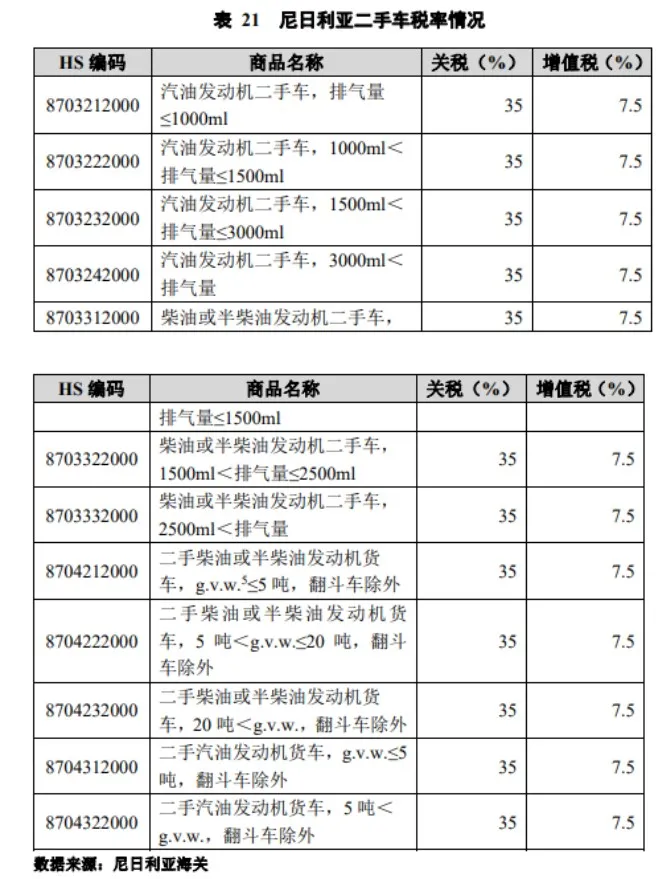
Imported used cars in Nigeria are subject to customs duty and VAT. According to the Nigerian Customs Tariff, Nigeria's tariff rate for used cars is 35%, and the value-added tax rate is 7.5%, as follows:
3. Documents required for import:
4. To export second-hand cars to Nigeria, you need to go through the following procedures:
(1) Complete the inspection of the place of unloading. Since December 1, 2013, Nigeria has implemented Destination Inspection (DI); Nigeria will release after inspection.
(2) Fill in Form M. Import enterprises fill in Form M through the authorized bank and register the Form M number in B/L or AWB.
(3) Advance Cargo Declaration. From January 1, 2016, before the goods enter the port of Nigeria, a pre-cargo application must be processed.
Here are a selection of EVs that are related to this news item.
If you found this news item to be of interest to you or you have any suggestions for future blog posts, please let us know. We are in China and have access to all the latest EVs. We can test drive or do a performance review of any EV you might be interested in. And if you are interested in importing to your country, please talk to us about becoming an EV B2B Agent.
Search in EV B2B
popular search terms: Chinese EVs, Hong Qi
Thank you for visiting us. Please leave a message and we will reply by email.