At the moment when the army is strong and ready to go to sea, trade barriers are frequently encountered. Will this stop the momentum of China's new energy going to sea? How will new energy companies respond?
01. New energy is a breakthrough made in China
Since China has become the factory of the world, we have heard a lot of jokes about Made in China. For example, the production of 700 million shirts can only be exchanged for a Boeing aircraft; foreign Internet celebrities challenged "not to be made in China," but their homes were evacuated; the supply chain and production bases were transferred to Vietnam, India, etc...
These statements are the epitome of Chinese manufacturing in different stages and periods. From copycat copying to high quality and low price, China's manufacturing is the same as Japan's and Korea's, step by step. Today, the new energy industry has become a new brand of Chinese manufacturing, and its products, technologies, and brands are comprehensively excellent, without bias.
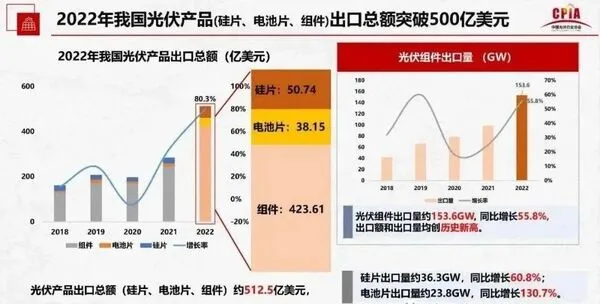
In 2022, China's total export of photovoltaic products (silicon wafers, cells, modules) will be approximately US$51.25 billion, an increase of 80.3% year-on-year; China's total export of lithium batteries will be 342.65 billion yuan (RMB, the same below), an increase of 86.7% year-on-year; the export of new energy vehicles will be 679,000 vehicles, a year-on-year increase of 1.2 times. Photovoltaics, electric vehicles, and lithium batteries constitute the "three new items" of foreign trade exports, all new energy sources.
![]()
Some people in the industry said that the current Chinese new energy market is too volatile, like a red ocean, while overseas is a blue ocean. China's new energy companies, especially power battery companies like Volkswagen and General Motors, entered other countries' markets with advanced technology in the early days of China's reform and opening up 40 years ago. Chinese new energy companies are also exchanging technology for overseas markets.
In November last year, the conversion efficiency of silicon heterojunction cells independently developed by LONGi Green Energy reached 26.81%, breaking the world record set by a Japanese company five years ago. In fact, in the photovoltaic industry, Chinese technologies bloom in many ways. The conversion efficiency of high-efficiency cells such as PERC, TOPCon, and heterojunction continues to rise, and module technologies such as half-cell, double-sided double-glass, MBB, and shingled are flourishing.
In June last year, Ningde Times released the third-generation CTP (cell-to-pack) battery - the Kirin battery, with a volume utilization rate exceeding 72%, and the battery pack integration level is the highest in the world. It was named the best invention of 2022 by Time magazine. A recent analysis by the Japanese media shows that in developing lithium-ion battery substitutes, including sodium-ion batteries, China ranks first with 5,486 patents, accounting for more than 50% of the total patents.
In key components such as "battery, motor, and electronic control, and intelligent innovation fields such as "smart driving, smart cockpit, and intelligent network connection," Chinese auto companies have also achieved leading technological advantages.
With the support of technology, China has cultivated several world-leading new energy companies. From 2018 to 2022, 8 of the top 10 manufacturers in global P.V. module shipments are from China, giving birth to several leading companies such as JinkoSolar, Trina Solar, LONGi Green Energy, JA Solar, and GCL Integration. According to data from the South Korean market research organization SNE Research, among the top ten global power battery companies in 2022, Chinese companies account for six seats, and CATL ranks first globally.
China's new energy going overseas will maintain strong momentum in the future. The Wall Street Journal quoted analysts at Citigroup as saying that China's electric vehicle exports are expected to continue their strong momentum in 2023 and grow by another 33%.
In terms of new energy, wind, light, charging, storage, and other links, China is mostly in the leading position in the world, and under the background of fierce domestic competition and foreign energy crisis, China's new energy has just begun to go overseas, and it still has huge market opportunities and potential.
02. There are frequent obstacles, and it is more difficult for new energy to go to sea
Under the current complex international situation, China's new energy is also facing challenges in going overseas. In August last year, the United States passed the "Reducing Inflation Act 2022", which called for 369 billion U.S. dollars to promote clean energy and encourage Americans to buy electric vehicles.
As far as China's new energy auto companies are concerned, they must be assembled in North America if they want to get tax breaks for their cars going overseas. The materials and "key minerals" in the batteries must come from the United States or countries that have free trade agreements with the United States.
In February this year, the U.S. government required that all-electric vehicle charging piles that receive subsidies from the U.S. "Infrastructure Act" must be manufactured in the United States. The final assembly of any iron or steel charger housing or casing and all manufacturing processes must be performed in the United States. Beginning in July 2024, at least 55% of the cost of charging station components must come from the United States.
Although the U.S. market is large, it is not yet a key market for China's new energy exports. The more realistic European market has also begun to set up "green barriers."
In March this year, the European Union released two proposals, the Net Zero Industry Act and the European Key Raw Materials Act, which aimed to increase the local production capacity of key green industries, such as photovoltaics and batteries, to 40% by 2030. By 2030, the annual consumption of strategic raw materials from a single third party should not exceed 65%, and related products from countries above 65% will be downgraded in tender evaluation, making it more difficult to obtain subsidies.
![]()
According to previous E.U. statistics, more than 90% of the organization's photovoltaic polysilicon and other related components are imported from China, and more than 40% of power batteries and new energy vehicles are imported from China.
The "White Paper on the Foreign Development of China's Photovoltaic Industry," recently released by the China Chamber of Commerce for Import and Export of Machinery and Electronic Products, shows that in the future, trade frictions in the photovoltaic industry may be upgraded again. In addition to traditional forms of trade frictions, barriers, and restrictions such as anti-dumping, anti-evasion, and raising basic tariffs, "human rights," "low-carbon certification," "energy efficiency labels," and "sustainable development" are becoming new forms of trade barriers, which put forward higher requirements for compliance operations of enterprises.
The "New Regulations on Battery Legislation" passed by the European Commission last year requires that from July 1, 2024, manufacturers and suppliers of industrial and electric vehicle batteries must provide product carbon footprint declarations. If Chinese battery companies want to land in the European market, another threshold must be crossed.
03. Curves go out to sea, each showing their special skills
Even so, Chinese new energy companies are still enthusiastic and willing to go overseas. In addition to the energy crisis and the dual-carbon policy, more important factors have brought about a surge in demand for distributed photovoltaics and wind power in overseas markets.
On the one hand, the domestic new energy industry has been saturated in stages. Data show that in 2022, the penetration rate of new energy vehicles in China will exceed 25%, and the installed capacity of power batteries will be about 260.94GWh, a year-on-year increase of 86%. What is certain is that in the next few years, the penetration rate of domestic new energy vehicles and the base of power battery shipments will continue to grow, and it will be quite difficult for related companies to maintain high growth over a long period.
On the other hand, China's new energy industry has begun to produce technology spillover effects. To a certain extent, today's new energy industry is a bit like the Chinese table tennis team, with domestic experts gathering, serious introversion, and some outstanding players choosing to go overseas for development. The technological advantages and product advantages of China's new energy industry can gain a foothold in overseas markets,
In response to the proposals of the E.U.'s "Net Zero Industry Law" and the "European Key Raw Materials Act," some photovoltaic industry insiders said in an interview, "It is not the first time that Chinese photovoltaic companies have faced so-called restrictions. They have overcome difficulties every time based on China's photovoltaic industry's technical strength and cost advantages. In addition, major photovoltaic enterprises are now building factories overseas and planning ahead of schedule, so the overall response to this risk is relatively calm."
After direct export is hindered, overseas construction of factories, joint ventures, technology transfer, and other curved ways to go overseas have increasingly become the choice of Chinese new energy companies.
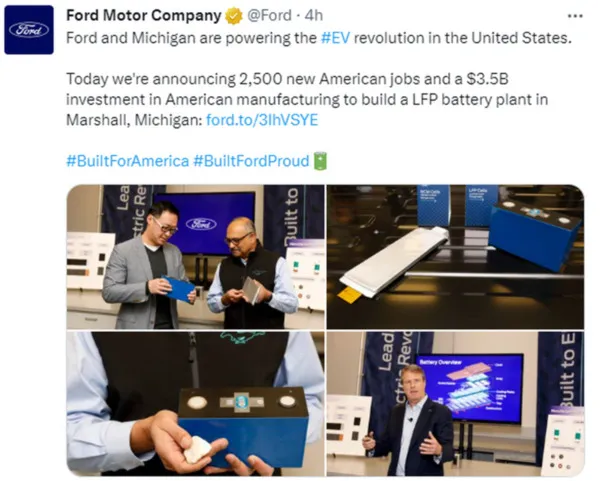
In February of this year, Ningde Times and Ford Motor agreed. Ford invested 3.5 billion U.S. dollars (about 24 billion yuan) in building a new lithium iron phosphate battery factory in Michigan, the United States, and held 100% of the shares through a subsidiary. Ningde Times will provide technical assistance and patent licensing support.
![]() Ningde era and Ford cooperated to build a factory in the United States.
Ningde era and Ford cooperated to build a factory in the United States.
One month later, the agreement was approved, which means that CATL bypassed the review of the "Inflation Reduction Act" with its "asset-light" technology output and became a sample of China's power battery technology going overseas.
According to Bloomberg News, Tesla is also seeking to cooperate with Ningde Times similarly to build a battery factory in the United States.
Another battery company, Guoxuan Hi-Tech, plans to invest US$2.36 billion through its U.S. subsidiary Gotion to build a battery module manufacturing plant in Grand Rapids, Michigan.
In March this year, it was reported that LONGi Green Energy would cooperate with Invenergy, an American clean energy developer, to build a 5GW photovoltaic module factory in Ohio, USA. Before this, J.A. Solar also announced that it would build 2GW of photovoltaic module production capacity in the United States, which is expected to be implemented in the fourth quarter of this year.
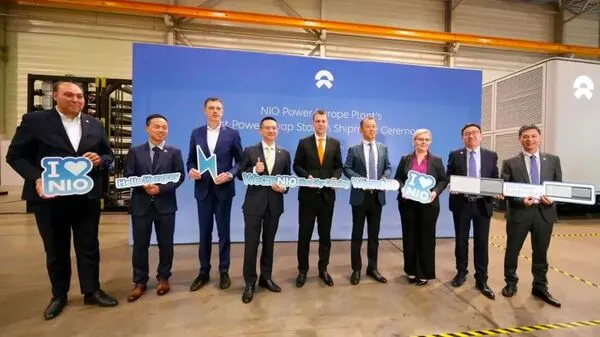
In September 2022, NIO Energy's European plant in Hungary will officially roll off its first battery swap station.
![]() NIO Energy's European factory settled in Hungary
NIO Energy's European factory settled in Hungary
BYD, which aims to become China's largest automaker by the end of this year, was also revealed to be planning to buy a Ford plant in Brazil. According to Reuters, the plant is located in Bahia, Brazil, with an annual production capacity of about 300,000 vehicles, and will cease production in 2021.
After the wave of Chinese products such as clothing, department stores, and home appliances going overseas, the new energy industry with high added value and high technology content will be the main force for Chinese products to go overseas in the next few years, and technology transfer and overseas factory construction will become the mainstream path.
Conclusion
In October 1984, China and Germany signed a joint venture contract in the Great Hall of the People in Beijing, and Shanghai Volkswagen Co., Ltd. was formally established. Volkswagen has introduced advanced manufacturing technology and a perfect quality management system into the country, opening a new chapter of "learning from teachers" in China's auto industry.
Thirty years in Hedong and thirty years in Hexi, China's new energy companies are now entering overseas markets as "teachers" through technology transfer. This is an opportunity of the times, resulting from the Chinese people's struggle.