With the vigorous development of China's independent brands in the past ten years, domestically produced cars, especially new energy vehicles, are rising strongly, and the share of domestically produced independent brands in the domestic auto market has also increased simultaneously. Accompanied by the collapse of belief in imported cars, imported cars that once stood at the top of the pyramid gradually stepped down from the altar.
 Imports fall, and exports rise.
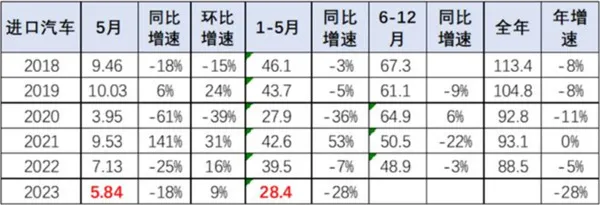
The latest data from the Federation of Passengers in May shows China's auto import and export markets are undergoing a double sky. Data show that China's passenger car imports from January to May were only 280,000 units, a sharp drop of 28% year-on-year. Among them, the import volume of automobiles in May was 58,400, a year-on-year decrease of 18%. On the contrary, the export of passenger cars from January to May was 1.381 million, a year-on-year increase of 102.0%, forming a huge contrast, especially since the total amount of imported cars has fallen to the lowest value in the past ten years.
The decline in car imports can be traced back as early as 2017. From 1.24 million vehicles in 2017, it continued to decline at an average annual rate of about 10% to 930,000 vehicles in 2020. Although the imported car market in 2021 will grow slightly by 0.1% year-on-year. But in 2022, the imported car market will further decline to 880,000.
However, it is worth noting that although the number of imported cars has declined, the demand for luxury cars (priced at more than 500,000 yuan) in the imported market is still growing, and the proportion of luxury cars has risen from 79.8% in 2019 to 91% in 2023. %. At the same time, the proportion of imports of ultra-luxury cars has increased slightly, reflecting that the purchasing power of ultra-high-end consumer groups has increased.
The emergence of this situation also shows that our independent brands do not have enough voice in the luxury car market, especially in a market with a price of more than 500,000 yuan. Outside the brand, the basic selling price is less than 500,000 yuan, leading to a counter-trend growth in luxury car imports.
The good news is that although the import volume of automobiles in my country has decreased greatly, the export volume has increased significantly. According to data from the Passenger Passenger Association, the export of passenger vehicles from January to May was 1.381 million, a year-on-year increase of 102.0%. Among them, new energy vehicles accounted for 30% of the total exports in May, and the export of self-owned brands reached 246,000, a year-on-year increase of 75.0% %. The Passenger Car Market Information Association predicts that my country's auto export scale will reach 4 million this year, which is expected to surpass Japan and become the world's largest auto exporter. The main reason behind the decline in imported cars and the surge in exported cars is that self-service brand-new energy models have killed the Quartet and quickly seized many overseas markets.
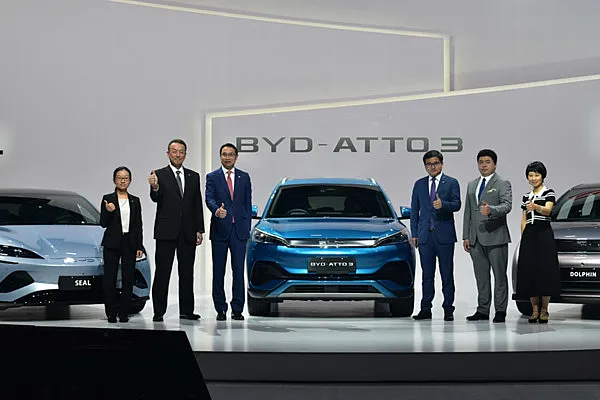
BYD opened stores in Japan, Weilai opened NIO houses in Europe, Deep Blue Roewe, and many other independent brands exported to the Middle East, Europe, South America, and other regions. The rapid rise of independent brand-new energy vehicles has helped China's auto industry to achieve cornering overtaking.
The import volume of Japanese brands dropped the most
Looking at the sales data of imported cars given by the Passenger Passenger Association, it is not difficult to find that the number of imports of Japanese luxury brands has dropped the most.
From the point of view of origin, from January to May 2023, imported Japanese cars have a huge drop, plummeting 53% year-on-year to 54,614, followed by American imported cars, which fell 33% year-on-year, Swedish imported cars fell 31% year-on-year, and German imported cars fell 31% year-on-year. Imported cars fell by 13% year-on-year. In contrast, Mexico's imports of cars increased by 28% year-on-year, and it was the only country of origin that achieved year-on-year growth.

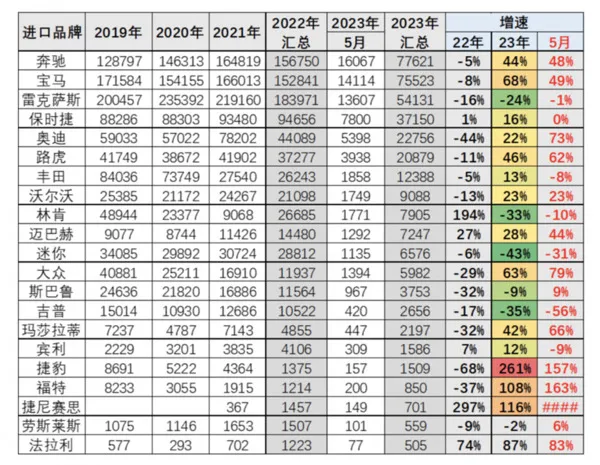
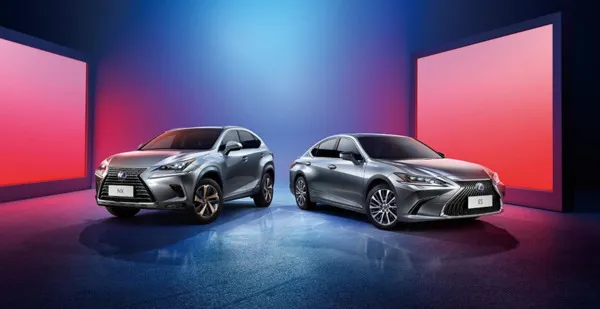
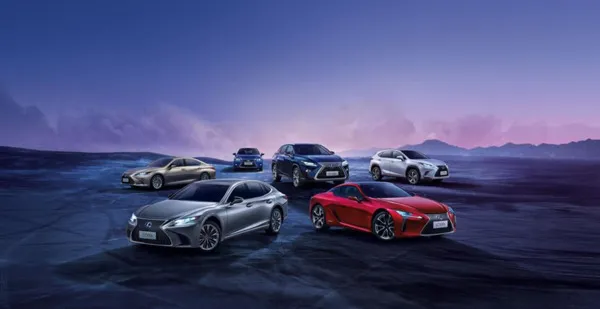
In terms of brands, from January to May 2023, the top three imported brands are Mercedes-Benz, BMW, and Lexus. Among them, Mercedes-Benz increased by 44% year-on-year to 77,621 units, and BMW increased by 68% year-on-year to 75,523 units. The decline is serious. According to data, Lexus sales fell by 24% year-on-year to 54,131 vehicles in the first five months of this year. It was the only brand that declined among the top three in the chart. Melon may further affect the market performance of Lexus. The other two Japanese luxury brands, Subaru and Infiniti, did not even enter the top 15, and their import volumes have been negligible.

In terms of models, Lexus ES and RX are the largest decliners among the top ten imported models. Among them, ES fell by 23%, RX was cut in half, and imports fell by 68%.
Cui Dongshu, secretary-general of the Passenger Travel Association, pointed out that the trend of traditional Chinese luxury cars in 2023 will be relatively weak. Still, the imported sales of major German brands will perform better. Among them, BMW X5 and Mercedes-Benz GLB will perform extremely well.
 Bitter fruit MINI
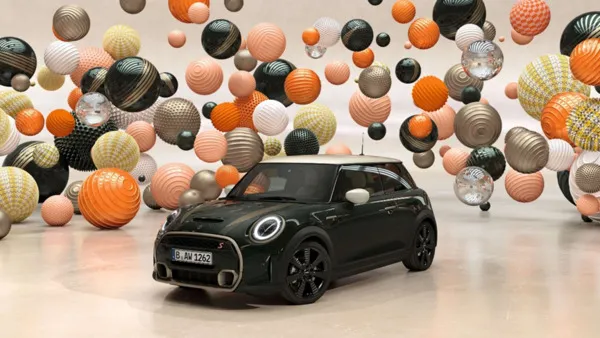
After the "ice cream event" at the Shanghai Auto Show this April, BMW MINI was pushed to the forefront. Although it is said that the Internet has no memory, the sales volume in the auto market will not be faked. MINI may be tasting the bitter fruit of the "ice cream incident" in April and May.
Judging from the sales in April and May, the sales of MINI have indeed been affected to a certain extent. I still remember that the decline of MINI in 2022 was only 6%, but from January to May this year, MINI directly plunged 43%, and the sales volume was only 6,576. If this continues, MINI can sell half of last year's sales in 2023, which is not bad.

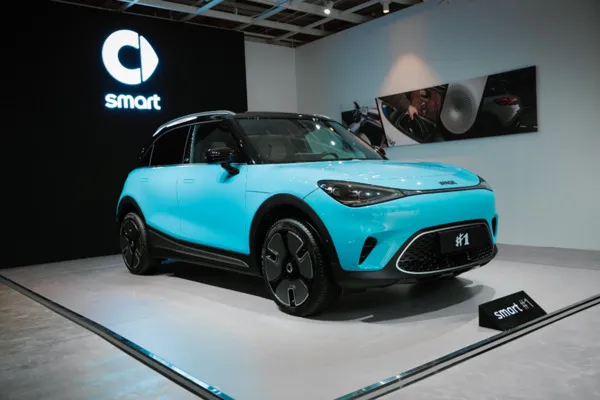
In addition, the decline in MINI sales has many similarities with Lexus. Without new technologies, it relies too much on its laurels and has not transitioned to new energy sources. It is not enough to unthinkingly rely on selling feelings. The smart next door has been actively transitioning to electrification, and the localization of the MINI electric version is still in a half-hidden state.

In the past five years, MINI's annual sales in China have stabilized at around 30,000 units, but this year, it is estimated that 20,000 units will be difficult.
With the rapid development of today's new energy vehicle industry, the penetration rate of new energy vehicles has increased yearly, and users' car-buying concepts have also changed. Because self-owned energy brands are in a new stage of vigorous development, most consumers now pay more attention to the cost performance and sense of technology of the whole vehicle and pay more attention to the real product strength, and no longer unthinkingly pursue imports and brand blessings. The traditional concept of "import is good" is gradually disappearing.
The era when imported cars were easy to sell is gone forever, and it is time for brands that rely on imported sales to re-formulate strategies, transform to new energy as soon as possible, develop new technologies, and improve product strength in new directions for future development.