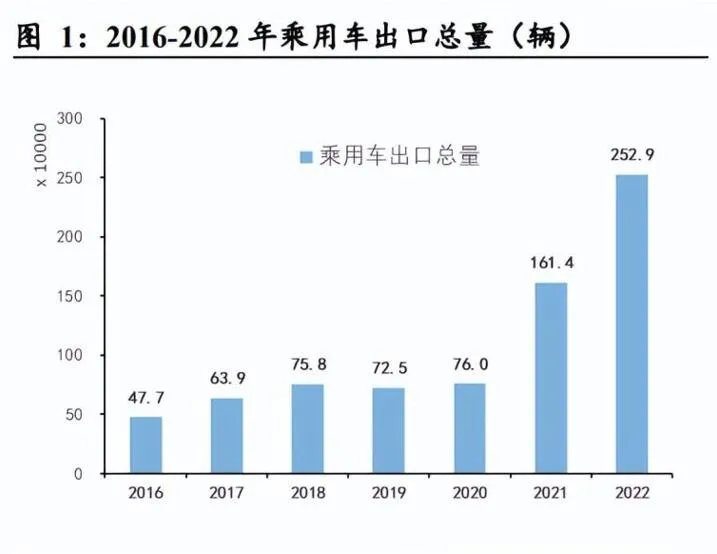
According to the China Automobile Association, the export of passenger cars in 2021/2022 was 1.61 / 2.53 million, +112%/+57% year-on-year. From January to May, passenger car exports were 1.47 million, nearly doubling the year-on-year growth. Among the major export car companies, the current representatives of local brand exports are Chery, Geely, Great Wall, BYD, Changan, and five other car companies. From the perspective of passenger vehicles, from January to May 2023, these five car companies exported 640,000 vehicles, accounting for 46% of the total exports of passenger vehicles, of which Chery's exports were approximately equal to the sum of the other four. From the perspective of new energy exporting overseas, in 2022, 610,000 new energy vehicles will be exported, and Tesla and SAIC MG will contribute 68% of the export volume. In addition, the current overseas new energy deployment is relatively fast. As for BYD, on the whole, the export of self-owned brand EVs is still in its infancy, lacking a sufficient supply of high-quality export models and needing further market development.
1. Status and driving factors of China's passenger vehicle exports
1.1. Total analysis: 2021-2023 China's passenger vehicle exports will show explosive growth
Since 2021, China's passenger vehicle exports have grown rapidly, and passenger vehicle export sales will contribute 10% of total wholesale sales in 2022. China's auto exports have shown explosive growth in the past three years. According to the China Association of Automobile Manufacturers caliber, passenger car exports in 21/22 were 1.61 / 2.53 million units, a year-on-year increase of 112%/+57%. Passenger car exports from January to May were 1.47 million, nearly double the year-on-year growth. Of course, the high year-on-year growth of passenger car exports this year is also related to the low base effect affected by the epidemic in the same period last year. The Shanghai plant exports a large amount at the beginning of the quarter (such as April/May ), and at the end of the quarter (such as June ), the production capacity is concentrated and delivered to China. Excluding the impact of Tesla, the monthly exports of other passenger car brands remain at around 290,000 vehicles.
![]()
Among the major export car companies, the current typical representatives of self-owned brand exports are Chery Automobile, Geely Automobile, Great Wall Motor, BYD, etc. From the perspective of passenger cars, the concentration of leading car companies is relatively high. Taking the export of passenger cars from January to May 2023 as an example, the top 3 car companies Chery Automobile, SAIC Passenger Cars, and Tesla accounted for 53%. The TOP10 car companies accounted for 85%. However, regarding divisions, automakers such as Tesla, SAIC-GM, and Dongfeng Easyjet belong to foreign capital or joint ventures.
In contrast, SAIC MG and SAIC MAXUS belong to SAIC's control and production technology brands. It is in the hands of SAIC, but the predecessors of both are British brands, which were acquired by SAIC in 2007 and 2009, respectively. Ordinary consumers often treat them as the original British brands when sold in the European market. Therefore, after subdividing the self-owned brands, the typical representatives of China's local brand exports are Chery Automobile, Geely Automobile, Great Wall Motor, Changan Automobile, and BYD. 640,000, accounting for 46% of the total export of passenger cars, of which Chery's exports are about equal to the sum of the other four. Analysis from the perspective of new energy vehicle exports, 2022The annual export of new energy vehicles is 610,000, accounting for about 26% of the total export of passenger vehicles and 9.4% of the total wholesale of new energy in 22 years. But specifically at the level of car companies, Tesla and SAIC Passenger Vehicle (MG) contributed 68% of the export volume. In addition, BYD and Chery are developing faster in overseas new energy. Great Wall, Geely, and other exports are still dominated by fuel vehicles.
1.2. Model structure: Exports are mainly fuel vehicles, and the main models are small or compact SUVs
From the analysis of the export fuel structure of passenger vehicles, fuel vehicles still account for most of the exports. New energy exports are dominated by pure electric vehicles, with fewer plug-in hybrids. According to the caliber of the Passenger Federation, from January to May 2023, a total of 1.38 million passenger vehicles in the narrow sense were exported, of which 970,000 were fuel vehicles, accounting for 70.5%, and 380,000 pure electric vehicles were exported, accounting for 28%. The export of mixed models was only 23,000, accounting for only 1.5%.
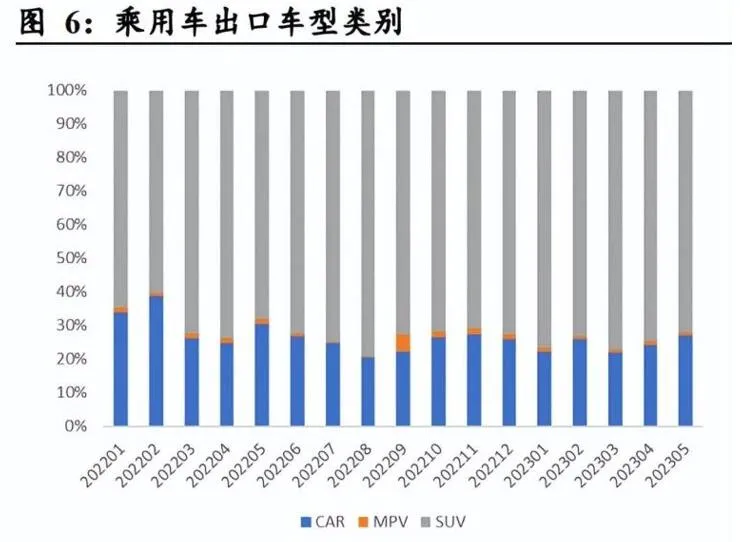
Regarding vehicle types, the export of fuel vehicles is dominated by SUV models, accounting for more than 70%. Among new energy exports, the ratio of SUVs to sedans is close to 6:4, and the overall export of MPVs is relatively small regarding vehicle types. Passenger car exports are dominated by A0 and A- class compact cars, accounting for nearly 80%. Among new energy vehicles, B/C- class mid-to-high-end new energy vehicles account for a relatively high proportion, mainly contributed by Tesla Model 3/Model Y.
![]()
From the point of view of the main export models, the overall supply of excellent export models is still relatively small. The main export models for fuel vehicles are the Chery Tiggo series, SAIC MG ZS/HS models, and others. From January to May 2023, the TOP15 models will contribute more than 60% of fuel vehicle exports, and there is still a lack of sufficient high-quality supply regarding the number of models. Regarding new energy, the TOP10 models will contribute 93% of exports from January to May 2023, and the overall sales will be driven by five models, including Tesla Model 3/Y, MG Mulan, MG ZS, and BYD Yuan. Focusing on five car companies, including BYD, Great Wall, Chery, Geely, and Changan, the current volume models are only a few, such as BYD Yuan and Euler Haomao, and the overall lack of sufficient high-quality supply.
1.3. Export areas: mainly in Europe, Southeast Asia + the Middle East, and other regions
According to customs statistics, from the perspective of automobile export regions, China's automobile exports 2022 will mainly be concentrated in Southeast Asia, the Middle East, Europe, and other regions. Compared with 2019, the proportion of exports in the European region has increased rapidly, mainly because Tesla Automobile brands represented by SAIC and SAIC MG have exported many products from Chinese factories to Europe in the past two years. In 2022, new energy will account for 60% of the export sales in Europe. As for exports to Southeast Asia + the Middle East, and other regions, from the analysis of fuel structure, although new energy accounts for nearly 40%, the new energy exported to Southeast Asia is mainly low-speed electric vehicles (called old-age scooters in China). With a huge population base, the economy is also developing rapidly, but the car penetration rate is generally low, and public transportation is underdeveloped. Low-speed electric vehicles with very high-cost performance can meet the basic travel needs of residents. Still, such models are generally not included in the scope of statistical caliber for passenger vehicles such as the Federation of Automobile Manufacturers and the China Association of Automobile Manufacturers.
1.4. Driving factors: supply chain advantages under the epidemic situation and core shortage, superimposed overseas layout for many years of intensive cultivation
The global epidemic in 2021 and the supply chain advantages under the shortage of automobile cores will enable China's automobile industry to seize the opportunity and export rapid growth. In 2021, China's passenger car exports will be 1.61 million, a year-on-year +112%, showing explosive growth. Before that, China's passenger car exports remained at around 600,000 to 700,000, without much growth. According to the National Bureau of Statistics guidelines, China's auto exports can maintain a relatively high growth rate in 2021, mainly due to two prominent factors: The auto industry has a long industrial chain and high requirements for supporting enterprises. China has a relatively complete industrial system and relatively strong supporting capabilities. In the context of the global epidemic, many foreign companies have encountered many problems in logistics, production supply, and chain, but my country has better advantages in these aspects. Secondly, China's epidemic prevention and control is also doing well globally. China's production and living order is well maintained and conducive to stable production operation. In addition, from an industry perspective, with the development of smart electrification, new energy vehicles use more chips than traditional fuel vehicles. In 2021, global sales of new energy vehicles will show explosive growth, triggering more demand for automotive chips. The big problem led to a more serious core shortage problem in the global auto industry in 2021. According to ASF estimates, China's overall auto production is less affected by chip shortages than the auto markets in the United States and Europe. In addition, although the 2021The annual shortage of cores has a certain impact on China's auto production, relying on dealer inventory as a buffer, China's overall auto sales and exports have not been greatly affected. In 2021, Q1-Q3, China's passenger car channel will destock 1.03 million, and by 21, In Q4 of this year, the problem of lack of cores in automobiles has been alleviated. Overall, under the background of the global epidemic and the shortage of automobile cores in 2021, China's supply chain advantages enable China's automobile industry to seize opportunities and usher in rapid export growth.
Regarding internal factors, the explosive growth of China's auto exports is also related to the overseas layout of Chinese brands for many years. Taking Chery Automobile, the auto company with the highest export sales among its brands, as an example, the reason why exports accounted for more than half of its total sales is mainly due to Chery's earlier layout of the auto export strategy and more in recent years. Enjoy the previous layout results. Chery has been laying out its overseas export strategy since 2001. After 20 years of intensive cultivation, its models have been sold to more than 80 countries and regions worldwide. In addition, Chery has established six major R&D bases, more than ten production plants overseas, and more than 1,500 overseas dealers and service outlets. Chery has already taken root in local markets such as the Middle East, Southeast Asia, and South America and has established a certain reputation and brand recognition.
2. BYD, the self-owned brand going overseas: entering the overseas new energy market
2022 will be the year of the export explosion, and the overseas sales of Yuan Plus will grow rapidly
2022 will be the "first year" of exporting BYD's new generation of models. From the perspective of overseas layout, BYD already deployed exports in the early stage 10 years ago, but the overall scale is small, and most of them are fuel vehicles. The whole new generation of electric models will start in June 2022, and export sales will grow rapidly. BYD has continuously made efforts in Thailand, India, Norway, Australia, New Zealand, Japan, Germany, and other countries and is rapidly entering the new energy vehicle market in Europe, Southeast Asia, and the Middle East.
Overseas consumers deeply love Yuan Plus, accounting for over 70% of the total export volume. BYD's export models are mainly Yuan, Han, and Tang series models, among which the Han and Tang series are mid-to-high-end models. Going overseas at this stage aims to build a high-end brand image and strive for profit margins. The sales volume of the Han and Tang series is not much. The BYD Yuan has a more cost-effective range, control, and power level, and the overall cost-effectiveness is higher, and it is also positioned as a mass-market model. Yuan plus overseas version - BYD ATTO3 has been widely welcomed in Israel, Thailand, Nordic, and other markets since its overseas release, although the average selling price is higher than in China. From January 2023 to April 2023, BYD exported 53,550 vehicles, of which Yuanplus exports accounted for 43,076 vehicles, accounting for 80% of the total exports.
Ocean series models are also slowly rolling out, and future sales will depend on the progress of certification and layout of models in various countries. In the cumulative export sales from April 2022 to April 2023, compared with Dynasty series models such as the Yuan Plus, the Dolphin and Seal accounted for a very low proportion, and the Dolphin only accounted for about 2%. BYD previously announced that Dolphin and Seal will soon be launched in Europe. Through cooperation with the British oil giant Shell, BYD users will enjoy the "Shell Recharge" fast charging service. Still, the actual sales in the future will depend on the certification progress and channel layout of each model in the European market speed, etc.
3. Great Wall Motors, the self-owned brand going overseas: steady growth in exports and self-owned fuel vehicles working together to seize the Russian auto market
3.1. Overseas sales are growing steadily, but fuel vehicles still dominate
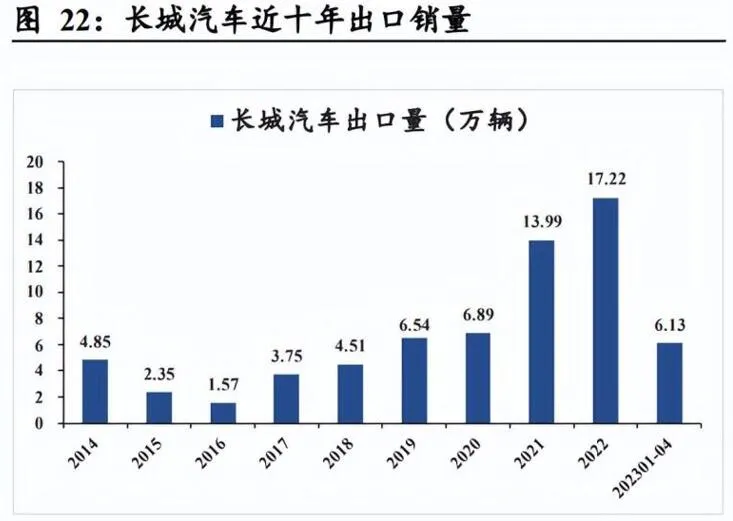
Overseas markets have expanded strongly, and the export volume of automobiles has maintained growth for seven consecutive years. Since the export volume reached a trough in 2016, the overseas sales of Great Wall Motors have continued to grow for many years in recent years, with a strong growth momentum. In 2021, after decades of overseas market layout, Great Wall Motors had also successfully seized the opportunity of Chinese auto exports, and its overseas sales have grown by leaps and bounds. In 2021, the export sales will be about 140,000 vehicles, double that of 2020. In 2022- The growth momentum will continue in 2023.
![]()
The Haval brand and Great Wall pickups are the main force for Great Wall Motors to develop overseas markets. Subdivided brands, from January 2022 to April 2023, the Haval brand will account for about 67% of Great Wall Motors' total exports, becoming the absolute main force, and this proportion will continue to rise. Since Great Wall launched its globalization strategy, it has developed globalized models in response to the needs of overseas customers and achieved synchronization between China and foreign countries regarding product configuration and intelligence. Regarding subdivided models, the models with the highest overseas sales of Great Wall are Great Wall Pickup, Haval H6, Haval F7, Euler, and Haval Big Dog.
Fuel vehicles still dominate; pure electric vehicles account for a small proportion. Great Wall Motors' overseas sales of fuel vehicles mainly include Haval F7, Haval H9, Haval H5, Haval Big Dog, tanks, and pickups. In contrast, new energy models only include Haval H6 PHEV, Latte PHEV, and Euler Haomao EV. From January 2022 to April 2023, fuel vehicles will always account for more than 50% of the share, and the proportion of plug-in hybrid vehicles will be stable. The sales volume changes will be consistent with the total sales volume of the month. Since 2022, Euler Haomao has been listed in many overseas countries, and it is the main product of the Great Wall to open up the overseas, pure electric market.
3.2. Overseas prices are generally higher than in China, and some markets have high tariffs
The main overseas markets of the Great Wall are Russia and Australia. The performance and configuration of most of Great Wall's overseas sales models are the same as those in China, but the overseas prices are much higher than in China. Compared with local brands in overseas markets, they generally follow the "high quality and high price" route. In the Russian market, the outbreak of the Russo-Ukrainian War caused Japanese, Korean, and German car companies to withdraw from the Russian market on a large scale. However, there are few large-scale car companies in Russia, their brand power is not strong, and market competition has temporarily weakened. Great Wall Motors is its representative brand and seizes the opportunity to seize the Russian market quickly.
Russia, Thailand, and other markets have higher tariffs on fuel vehicles. Russia's vehicle tariff rate is 25% + 20% value-added tax, which is relatively high. Great Wall Motors has invested in a full-process manufacturing plant in Russia, which will be officially operated in 2019. It will ship Chinese parts to Russia for processing, which can reduce the pressure of tariffs to a certain extent. In 2021, Great Wall Motor's full-process manufacturing plant in Rayong, Thailand, will be put into operation. Still, due to the imperfect local industrial chain and the factory's early stage, China's complete vehicle export support is needed.
3.3. To seize the Russian market, the market share of self-owned brands represented by Great Wall Motors has risen rapidly
Russia is the largest overseas market for Great Wall Motors. According to statistics from Marklines, in 2022, Great Wall Motors' total overseas registration volume will be 126,000 vehicles, and the Russian market will account for nearly 29%, making it the largest export market for Great Wall Motors. In 2022, the Russia - Ukraine War broke out. Affected by Western sanctions, Russia's economic situation was grim, and the auto market experienced severe shocks. Japanese, German, and Korean auto companies were largely withdrawn from the market. This also affected Great Wall Motors; its sales in Russia fell by 9.8%, but the impact was less than other Japanese and South Korean car companies. Moreover, after entering 2023, the overall impact of the Russia-Ukraine War is gradually disappearing. Weak, the Russian auto market ushered in a strong recovery.
Some Japanese, Korean, and German brands withdrew from the Russian auto market, and the market share of Chinese brands increased. The Russian market itself is highly dependent on foreign auto brands. Ford, Volkswagen, and Renault all have production lines in Russia. In 2022, affected by the Russia-Ukraine war and Western sanctions, Hyundai - Kia, Volkswagen, Toyota, and other car companies will have a sharp drop in their market share in sales, while the sales of local Russian companies and Chinese car companies will decline less, showing a certain degree of resilience. And in terms of market share, they ranked the top two with 39.40% and 18.07%, respectively. The competition pattern of the entire Russian auto market has undergone drastic changes.
4. Geely Automobile with its brand going overseas: a multi-brand strategy to enter the auto market in Europe and Southeast Asia
Russia is Geely's largest overseas market.
Russia has become the number one market for Geely's overseas sales. According to Marklines data, in 2022, Geely's overseas registration volume will be 101,000 vehicles, of which sales in the Russian market will account for about 24%. From January to April 2023, Geely's sales in the Russian market accounted for 49%, far exceeding other overseas markets. In addition, the Lynk & Co brand has established a good reputation in the European market. Lynk & Co 01 has established a good market foundation in the Netherlands, Italy, Germany, and other European countries.
The overseas prices of Geely models are generally higher than those in China. Affected by various factors such as tariffs, shipping costs, and brand image building, Geely's overseas prices are generally higher than those in China. Among them, the price of Boyue in Malaysia (Proton X70 ) is 163,800 to 203,300 yuan, 60% higher than that in China, and the price of Binyue in the Philippines is 162,800 to 177,400 yuan, 80% higher than that in China.