In the important SUV segment, the Volkswagen Group has a total of 30 models. No other manufacturer has such a comprehensive model pedigree as the Volkswagen Group. By 2030, Volkswagen will launch a total of 17 new gasoline models.
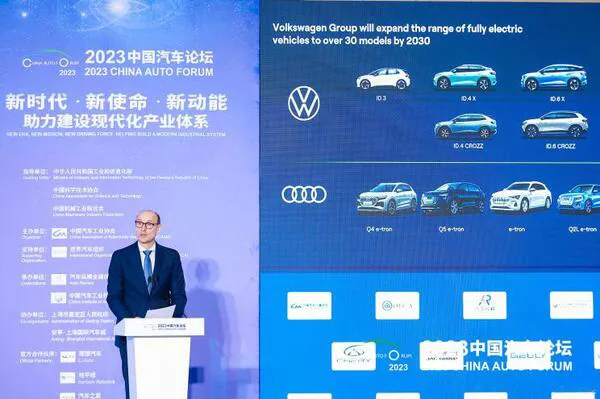
At the end of this year, Volkswagen's new joint venture, Volkswagen Anhui, will officially start production. In addition to the pure electric model Cupra Tavascan, which will be exported to the European market, another Volkswagen brand model is expected to roll off the assembly line in 2024. Audi FAW New Energy Vehicle Co., Ltd. will also start production in Changchun by the end of 2024. Audi will launch three new models in 2025 and 2026. By 2030, the Group's brands will have no less than 30 pure electric models.
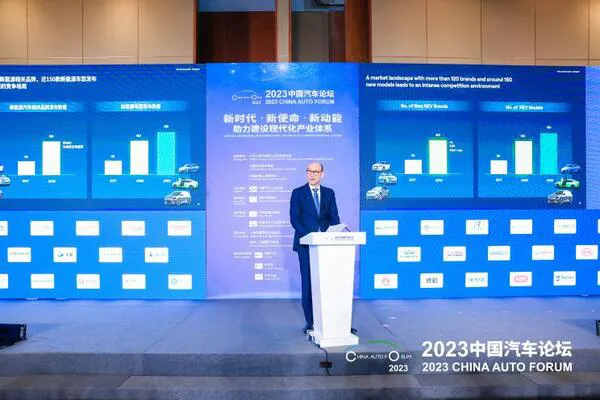
The theme of the 2023 China Automobile Forum is "New Era, New Mission, New Momentum to Help Build a Modern Industrial System". Focus on multiple topics such as dual-carbon, intelligent networked vehicles, software-defined vehicles, chips, market consumption, data ecology, digitalization, globalization, high-level openness, and sustainable development, from macro policies to industry trends to implementation Measures, comprehensive and in-depth discussions on key development issues that are widely concerned both inside and outside the industry. As an official partner, Autohome participated in the whole event.
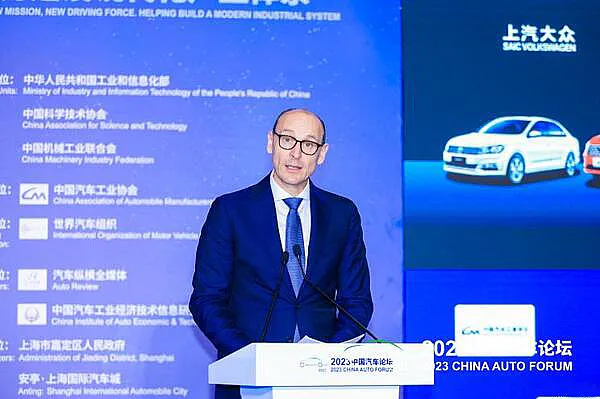
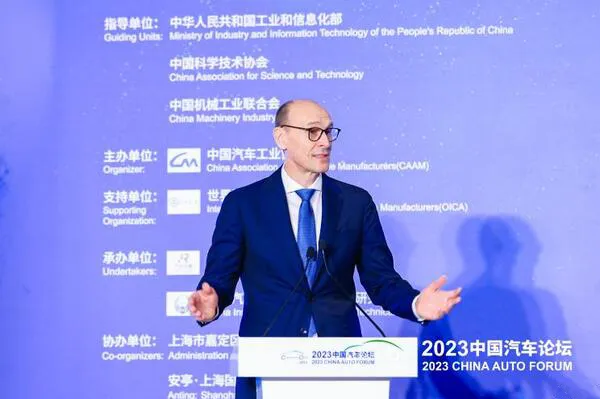
 "Volkswagen Group (China) Chairman and CEO Bernard"
The following is the content record:
Ladies and gentlemen, distinguished guests, thank you very much for your invitation. It is a great pleasure to be with you today.
In today's rapid transformation of the auto industry, especially China's auto industry, such industry conferences are very necessary. Looking at the world, no country can match China's speed of transformation and innovation in the auto industry. China has long been a global auto industry powerhouse. Therefore, regular communication within the industry and discussions on the future of mobility are very important.
Volkswagen wants to help shape the future. Having been deeply involved in the Chinese market for 40 years, Volkswagen has brought convenient personal mobility to tens of millions of people by joining hands with the two major partners of SAIC and FAW. We are working with Jianghuai Automobile to establish the third joint venture in Anhui and will launch new products soon.
We continue to promote the modernization of China's auto industry, thereby helping China's rapid industrialization process, and in the process, we have established a strong supplier system that serves the entire industry.
In the past 40 years of development, cooperation has always played an important role. We will continue to actively cooperate with other manufacturers, suppliers, and the government to promote the development of China's auto industry. In the new stage of mobility development, it is very important to maintain close contact and communication between all parties on important issues, such as new industry standards. It is for this reason that events like today are invaluable to industry development. We would like to thank the China Association of Automobile Manufacturers for its efforts in making this forum a success.

Ladies and gentlemen, China and Volkswagen have a deep historical relationship, and we will continue to develop on this basis. Together, we will once again shape a new era of personal mobility. With the vigorous development of intelligent and connected vehicles, this new era is coming to us.
In China, Volkswagen hopes to continue to play a leading role in the new era. The next few years are critical. The Group has formulated and is implementing a development plan for 2030. Our "2030 Goals" consist of three important pillars:
First of all, we will continue to leverage our advantages in the fuel vehicle market. This year, Volkswagen Group's share in China's fuel vehicle market has increased from 18% to 20%. In the next few years, we will continue to strengthen our product lineup with new models such as the new Tiguan, Sagitar, Magotan, Audi Q4, and Q8. In the important SUV segment, the Volkswagen Group has a total of 30 models. No other manufacturer has such a comprehensive model pedigree as the Volkswagen Group. By 2030, we will launch a total of 17 new fuel vehicles. At the same time, we are investing heavily in the development of new technologies, such as advanced driver assistance functions focused on the Chinese market and new in-car navigation systems. Both innovations have benefited from local research and development, as well as extremely efficient collaboration with joint venture partners.
In addition, we are promoting the development of hybrid technology, gradually transforming gasoline vehicles into plug-in hybrid vehicles, and becoming a strong player in this market segment.
We will give full play to our advantages in the fuel vehicle market. Although the overall size of the fuel vehicle market is shrinking, the Group still maintains considerable profitability by its own scale and cost advantages. This will provide the necessary financial support for the development of the Group's intelligent connected vehicle business in China.

Second, we will accelerate the offensive of pure electric products. Last year, we launched three new models, Audi e-tron GT, Q4 e-tron, and Q5 e-tron. During the Shanghai Auto Show, we launched the ID.7, the first pure electric sedan of the Volkswagen brand. The first models will be delivered to customers in autumn. At the end of this year, our new joint venture Volkswagen Anhui will officially start production. In addition to the pure electric model Cupra Tavascan, which will be exported to the European market, another Volkswagen brand model is expected to roll off the production line in 2024. Audi FAW New Energy Vehicle Co., Ltd. will also start production in Changchun by the end of 2024. Audi will launch three new models in 2025 and 2026. By 2030, the Group's brands will have no less than 30 pure electric models.
Third, further deepen the development of "in China, for China". Based on the "in China, for China" strategy, in the future, we will pay more attention to the development of local technologies, make better use of local innovation forces, and respond more quickly to the needs of Chinese consumers. To this end, Volkswagen is rapidly expanding its local development capabilities.
Not long ago, the Group announced the establishment of a new research and development company in China: Volkswagen (China) Technology Co., Ltd. The group has invested more than 7.5 billion yuan in Hefei for this purpose. The new company will become the group's largest research and development center outside the German headquarters, focusing on the development of advanced electric vehicles and intelligent networked vehicles. In the future, more than 2,000 R&D personnel will be engaged in the research and development of new products here. At the same time, through close cooperation with the procurement team, existing and new supplier partners will be able to participate in the product development process at an early stage.
CARIAD China, a software subsidiary of the Group, is also continuously improving its research and development capabilities. Its headcount of software specialists will grow from 800 in 2022 to about 1,200 by the end of this year, including employees of the joint venture that CARAID is forming. At least 90% of these employees are local Chinese software talents. At the same time, we will adjust CARIAD, focus on the functional integration of software products and vehicles, and work closely with local partners.
In addition to continuously improving our strength, we also establish partnerships with powerful local companies. By joining hands with Thundersoft, a well-known smart operating system product and technology provider, we will jointly develop an infotainment system suitable for the Chinese market. In the field of autonomous driving and chip design, we have established a long-term cooperative relationship with Horizon.
In 2021, we acquired about 25% of the shares of the battery manufacturer Guoxuan Hi-Tech. In the future, we will produce standard batteries through Guoxuan Hi-Tech. The company is an important part of the group's global battery strategy. Based on this, we are building factories in the US, Europe, and China. At the same time, we will also ensure a direct, own supply of raw materials, allowing us to rapidly improve battery performance and significantly reduce costs. In the Chinese market, we will also flexibly apply different chemical materials such as lithium iron phosphate or lithium nickel cobalt manganese oxide.
In addition, our decision-making needs to be more agile. To this end, Volkswagen has been given more autonomy and decision-making power in China. Under the new management model, we are also making more "in China, for China" decisions. As a result, Volkswagen Group (China) is gradually becoming the second headquarters of the group.

Ladies and gentlemen, Volkswagen is accelerating its development at "China speed". Through these investments and cooperation, the development cycle of the Group's new products and technologies will be shortened by about 30%, and its competitiveness will be significantly enhanced.
With the rapid development of technology, we have formulated a development plan for the most advanced intelligent connected vehicles for the Chinese market.
At the same time, we are continuing to expand and optimize the existing electric model matrix. The new models will further strengthen our position in the fast-growing Chinese electric vehicle market.
It is expected that the market share of new energy vehicles in China will exceed 30% this year, and this proportion will exceed 50% by 2025. It is estimated that by 2030, the annual sales volume of China's auto market will increase to 28 million to 30 million vehicles, of which new energy vehicles will account for 74%, and pure electric vehicles will account for more than 55%. At that time, there will be no less than 30 pure electric models on sale under the brands of the Volkswagen Group.
The continuous subsidy policy has injected continuous vitality into the development of the electric vehicle market, which is of great significance in the initial stage of the electric transformation of the automobile market. For consumers, subsidy policies are an important incentive. Thanks to this, China has become a leader in the transformation of the automotive market to full electrification.
We very much welcome the new electric vehicle tax plan, which will help accelerate the green transition. These purchase incentives will ensure that the mass-produced segment further benefits from the electrification transition and ensure the adoption and expansion of electrification across the market.
However, we are facing a situation where the market is overheated. Currently, there are more than 120 automakers on the market, and about 150 new models will be launched in 2023. The fierce competition has even led to deep price discounts in recent months.
At present, many automakers are highly dependent on the pure electric vehicle business due to the lack of support from other businesses. Intense market competition and high power battery prices make them face severe economic pressure. Short-term sales success requires extremely high capital investment. These inputs cannot contribute to the long-term positive development of the market.
Some analysts said that about 80% of the start-ups that have entered the electric vehicle market in recent years are currently or are about to withdraw from the market, or are in urgent need of new capital investment. Consolidation of the playing field is in full swing.
This will ultimately harm the interests of consumers. They will no longer be able to get services from retired brands, or they will see a significant price cut on the models they buy. In this environment, stronger brands, including Volkswagen and Audi, can continue to provide consumers with stable and reliable services.

Ladies and gentlemen, one thing is clear: Even in the current challenging environment, the Volkswagen Group is committed to sustainable business growth, but we do not pursue growth at all costs. For us, the profitability of the business is the most important. We will not engage in unhealthy market competition to achieve short-term delivery growth.
We can initiate and implement major investments, such as investing in the establishment of Volkswagen (China) Technology Co., Ltd. We can prepare for the next stage of market development, and at the same time, we can better achieve a profit balance between the gasoline vehicle and the pure electric vehicle business.
Ladies and gentlemen, from the perspective of international automakers, China has become our "fitness center". We have to "train" ourselves harder and faster to keep up with market trends. In recent months, the group has taken a series of important measures in the development strategy of the Chinese market. With our "2030 Goals" and "In China, For China" strategy, we are systematically preparing for new and important technological breakthroughs. In the process, we are laying a solid foundation for the group's future development through the group's strong brands, strong joint venture partners, enhancement of localized research and development capabilities, and cooperation with Chinese technology companies. We have launched many key projects, and this pace of development will continue. Our goal is clear: to play a leading role in the field of intelligent connected vehicles! In this regard, we already have a strong layout, and everyone can continue to have full confidence in us! I very much look forward to communicating with you all. thank you all.