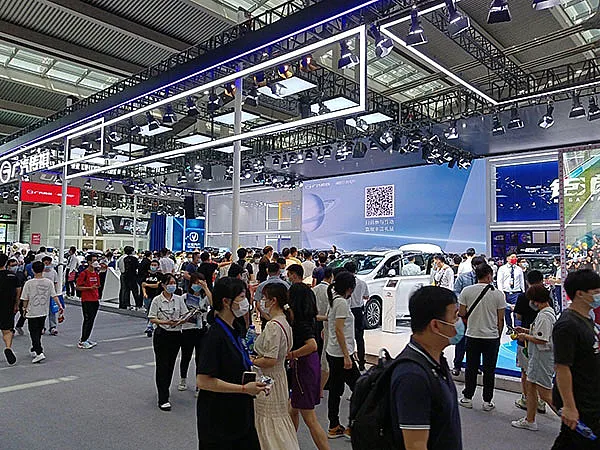
Benefit from the perfect industrial chain and the competitive advantage of new energy vehicles
Automobiles are a synonym for advanced manufacturing. China has been catching up for decades, and Chinese automobiles have been monopolized by Japanese, German, and American automobiles. The development of domestic automobiles has been suppressed, and the market share was once only 20%.
In the past decade, China has vigorously cultivated the new energy vehicle industry chain, introduced policies to provide tax incentives for vehicle purchases, and developed the charging pile and battery industries. China's new energy industry chain is leading the world and becoming increasingly mature. Last year, because of the high international oil prices caused by the war between Russia and Ukraine, China's new energy vehicles continued to grow explosively, with production and sales of 7.058 million and 6.887 million units, respectively, an increase of 96.9% and 93.4% year-on-year, remaining the world's first for eight consecutive years. This move is undoubtedly due to China's forward-looking and wise policy.
A set of data can be more illustrative. Last year, China's independent car brands significantly improved, especially the competitiveness of new energy vehicle brands. The mainland market sales accounted for nearly 80% of the year, an increase of 5.4 percentage points; similarly, the high global oil prices make new energy vehicles shine, promoting China's new energy vehicle exports last year sought after, reaching 679,000 units, a year-on-year surge of 1.2 times. China occupies 3 of the top 10 global new energy vehicle sales groups and 6 of the top 10 companies in installed power battery capacity.
Data for the first quarter of this year showed that China's auto exports were 1.07 million units, up 58.1% year-on-year, according to data from the General Administration of Customs recently compiled by the China Association of Automobile Manufacturers. And Japan's first quarter auto exports of 954,000 units, up 5.6% year-on-year, China is nearly 120,000 units higher than Japan, jumping to become the world's largest auto exporter.
The author, according to the structure of China and Japan's exports of cars, can be seen China's new energy vehicles accounted for a more advantageous. At the same time, Japan's focus is still on fuel cars. New energy vehicles accounted for not very high, so according to this trend, coupled with many countries around the world, the public's preference for new energy vehicles, so China's annual exports of cars this year are still expected to exceed Japan in the world's first.
As a high-value-added and high-tech product, I believe that the automobile undoubtedly enhances the confidence and advantages of China's advanced manufacturing industry. New energy pure electric vehicles are working with solar cells and lithium batteries to become China's exports of the new three. The development momentum is unusually rapid, and the pace is too fast. In 2021 and 2022, China's auto exports exceeded South Korea and Germany, respectively, and this year, with the support of new energy vehicles, is likely to continue to be high in the global first.
In the future, China's new energy vehicles must do a good job in many countries worldwide to localize services such as battery maintenance, repair, and renewal, help develop charging piles in importing countries, and improve customer service levels, etc. After all, brand and reputation are important cornerstones for the long-term international development of Chinese cars.